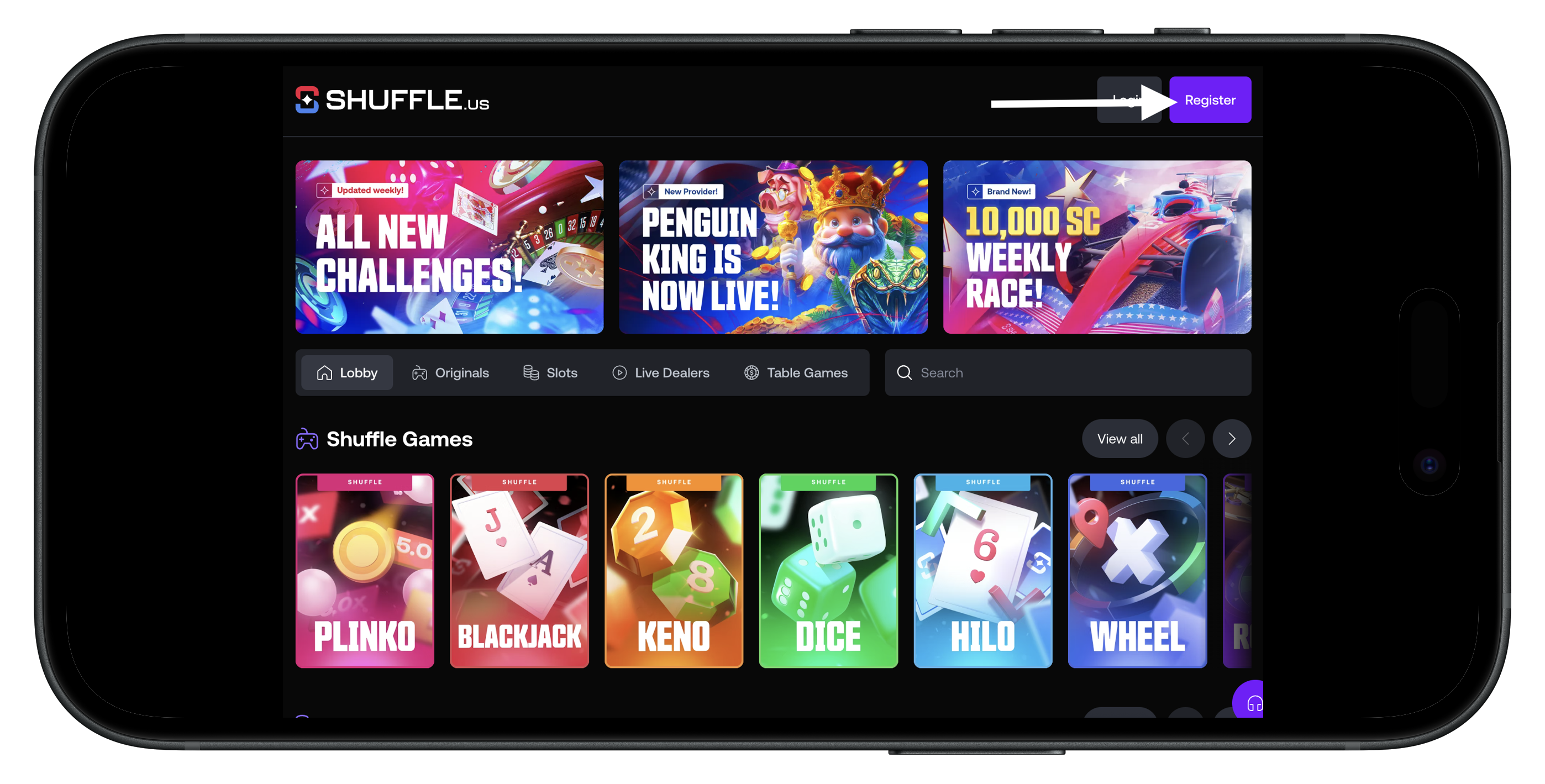
When we create an account at Shuffle Casino, the age requirement is the first legal checkpoint. In Canada, online gambling age is set provincially, so the limit can be 19 or 21 depending on where we reside. Shuffle Casino applies a consistent standard that aligns with the strictest applicable rules, typically requiring players to be at least 19. During registration, we provide our date of birth, and the system immediately blocks underage attempts. Even if an incorrect date slips through, the later Know Your Customer process will catch the discrepancy. This layered approach protects both the operator and players, and we should confirm our eligibility before starting. The registration journey involves identity verification, secure login setup, and responsible gambling tools, all of which we will walk through step by step.
Identity Verification and Know Your Customer Requirements
KYC verification is mandatory before any withdrawal. It fights fraud, money laundering, and underage gambling. The process generally starts after a withdrawal request or when cumulative deposits reach a threshold. We will be asked to upload a government-issued photo ID, a proof of address document dated within the last 90 days, and sometimes proof of payment method ownership. A driver’s licence or passport is acceptable for ID, while a utility bill or bank statement satisfies the address requirement. montrealgazette.com The compliance team examines submissions, and automated checks often approve documents within minutes; manual reviews may take up to 48 hours. To avoid rejection, we must ensure images are clear, well-lit, and show all four corners. Once verified, our account is fully activated, and re-verification may be asked periodically for security.
Commonly Requested Documents
- An acceptable passport, driver’s licence, or national identity card showing full name, photograph, and date of birth.
- A current utility bill, bank statement, or government correspondence displaying full name and residential address, dated within the last 90 days.
- For card deposits, an image of the front of the credit or debit card with only the last four digits, name, and expiry date visible; the CVV must be covered.
- In some cases, a selfie holding the ID or a short video may be required to confirm liveness.
Typical Registration and Login Difficulties and How to Resolve Them
Not receiving the verification email is a typical hurdle. The message often ends up in the spam or promotions folder, so we should examine there first and add the sender to our contacts. If it still does not arrive, we can employ the “Resend Verification Email” option on the login page, ensuring that we entered the correct address. Account lockouts after multiple failed login attempts are a security feature that temporarily disables access for 15 to 30 minutes. Rather than trying again, we should wait and then utilize the “Forgot Password?” link to create a new password. Document rejection during KYC usually stems from blurry images, expired IDs, or name mismatches. The rejection notice indicates the reason; we must resolve that exact issue—retake the photo in good light or correct the name discrepancy—before resubmitting, as uploading the same problematic file will only cause another rejection.
Securing Your Account: 2FA and Password Optimal Habits
Once our account is active, activating two-factor authentication is the most impactful security step. Shuffle Casino works with authenticator apps like Google Authenticator, which generate time-based codes. With 2FA active, logging in demands both our password and a unique code from our mobile device, so a stolen password alone is ineffective. We should enable this feature during the first session. Beyond 2FA, we must use a unique password not duplicated on other sites. A passphrase of random words or a manager-generated string withstands brute-force attacks. We should also be vigilant to phishing attempts; the operator will never ask for our password via email or chat. If we detect compromise, we should reset the password immediately and ensure 2FA is enabled.
Enabling Two-Factor Authentication
- Sign in and navigate to “Security” or “Account Settings.”
- Select the two-factor authentication option and click “Enable.”
- Get an authenticator app (Google Authenticator or Authy) on your smartphone.
- Read the QR code displayed on screen or type in the setup key.
- Enter the six-digit code generated by the app into the confirmation field and hit “Verify.”
- Store the backup codes provided in a secure, offline location for account recovery.
Comprehending the Minimum Age to Create an Account at Shuffle Casino
The lowest age to open an account is not a uniform national number. Because Canadian gambling law is provincial, the legal age can be 19 in provinces like Ontario and British Columbia, while some regions require 21. discover here Shuffle Casino generally places the floor at 19, but the registration system may dynamically impose a higher threshold based on the address we provide. The age gate is absolute; attempting to register while underage violates the operator’s policies and can lead to permanent account closure and forfeiture of any deposited funds. The date-of-birth field initiates an instant eligibility check, and if we fail it, the process stops. Later, identity verification will cross-reference our submitted documents, so any mismatch will freeze the account until we supply valid government-issued identification that proves our age.
Lawful Gambling Age in Canadian Provinces
Provincial age limits vary: Alberta, Manitoba, and Quebec set the casino gambling age at 18, but most regulated online markets like British Columbia and Ontario use 19. A few land-based venues and territories require 21. Shuffle Casino, as an international platform, uses 19 as its baseline to cover the majority of Canadian players. However, the terms displayed during sign-up will state the exact age requirement based on our jurisdiction. We should never assume that reaching the legal drinking age automatically qualifies us to gamble online. The only reliable confirmation is to read the eligibility clause on the registration page or contact customer support before depositing. This clarity eliminates wasted effort and ensures we start on the right side of the rules.
Complete Account Creation Process
The registration form requests essential details to verify our identity and comply with anti-money laundering rules. We start with a valid email address and a strong password, then input our full legal name exactly as it appears on our ID. Any nickname or omitted middle name will result in verification delays. Next, we pick our date of birth, which initiates the age check, followed by our residential address, phone number, and preferred currency. After submitting, we receive a verification email; clicking the link enables the account. At this stage we can browse games and deposit, but withdrawals remain locked until identity verification is complete. Taking an extra minute to double-check every field—especially the address matching our proof-of-address document—establishes the foundation for a smooth KYC experience later.
Logging In and Overseeing Your Credentials
Accessing our account is easy: we enter our email and password on the login page, then submit a 2FA code if enabled. A “Remember Me” option can minimize prompts on personal devices, but we should only employ it on a device protected by a screen lock. Logins from new devices or locations may prompt a verification email to confirm our identity. We can update our password anytime from account settings, and revising the registered email requires additional verification. If we misplace access to our authenticator app, the backup codes saved during setup are crucial; without them, we must reach support for manual identity recovery. Biometric login on mobile devices presents a handy alternative, using fingerprint or face recognition to open a locally stored token without transmitting biometric data to the casino.
Continuous Account Security and Responsible Gambling Tools
Shuffle Casino offers integrated responsible gambling tools that protect our financial well-being. From the account settings, we can configure daily, weekly, or monthly deposit limits. Once a cap is reached, further deposits are prevented until the period resets. Loss limits work in the same way, restricting net losses over a defined timeframe. Decreases to limits take effect immediately, while increases are bound by a cooling-off period to prevent impulsive decisions. Time-out and self-exclusion options offer breaks ranging from 24 hours to several years. During self-exclusion, the account is closed and the operator takes appropriate steps to prevent new account creation. Session time reminders can also be configured to help us stay aware of playing duration. These tools, combined with strong login security, create a complete safety net for our identity and funds.
Setting Deposit and Loss Limits
We can locate deposit and loss limit controls under the “Responsible Gambling” or “Account Limits” tab. To set a deposit limit, more information, we enter the maximum amount we are confident depositing per day, week, or month. The system tracks all deposits and declines any transaction that would exceed the cap. Loss limits are calculated on net losses—deposits minus withdrawals—over the chosen period. If we attempt a deposit that would push us over the limit, the transaction is blocked and an on-screen notification appears. Any request to increase or remove a limit undergoes a required waiting period, typically 24 hours or longer, giving us time to reconsider. This built-in friction encourages disciplined play and ensures that our budget controls remain in our hands.
اترك تعليقاً